
Chapter 20A
Risk Taking at Airtours
Sometimes the biggest risk isn't doing something that looks risky. It's being too cautious to recognise when doing something five times bigger makes considerably more commercial sense.
Risk Taking at Airtours
One of my unofficial roles at Airtours was being part of David Crossland’s trusted circle that looked at new projects and tried to work out the risk versus potential return. It sounds rather grander than it actually was, because Airtours was never a business that produced hundreds of pages of strategy documents before making a decision. We did the numbers, argued about them, and then David assessed whether the risk was worth taking and made a decision to go ahead or not.
1993
So, in the summer of 1993, I found myself spending months sitting across the table from various cruise experts, learning about the costs of operating ships, potential base ports and different itineraries.
Airtours was fundamentally a mass-market package holiday company, so our thinking was quite simple. Could we take what we had done to package holidays and apply the same principles to cruising?
We eventually settled on Majorca as the main base and designed two seven-night “butterfly” itineraries on a full-board basis. Customers could take either cruise individually, combine both to create a 14-night cruise, or add a week's cruise to a week's holiday in Majorca. Importantly, this also fitted our predominantly 14-night aircraft flying patterns, allowing us to use the infrastructure and flying programme we already controlled.
Typically, David approached the whole exercise backwards.
Instead of asking what operating a cruise ship cost and then adding a margin, he decided what he thought an Airtours customer would pay and told us to work backwards from there.
His number was around £499 per person.
That was roughly a 50% premium to the average package holiday price we were selling at the time, but dramatically cheaper than the traditional cruise companies, where customers were paying nearer £1,500. David believed there was a massive gap between the two markets and that Airtours customers would happily pay a bit more than their normal holiday price to experience cruising.
There was just one slight problem.
I couldn't make the numbers work.
No matter how I played with the assumptions, I couldn't make operating a single cruise ship sufficiently profitable at the price David wanted to charge. Eventually I reported this back to him, expecting that to be the end of the idea.
David simply said, “OK, leave it with me.”
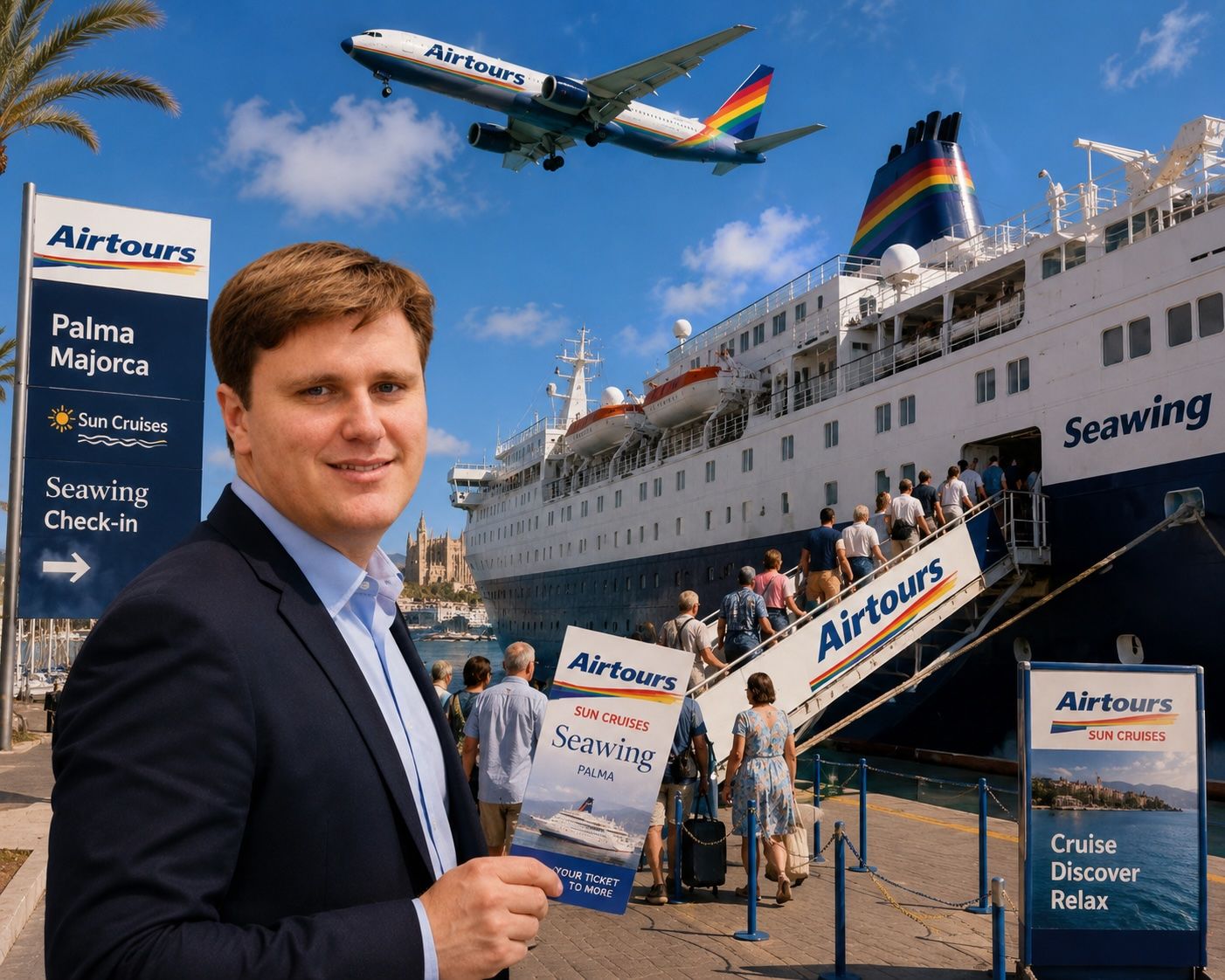
About three months later I was therefore slightly gobsmacked when he announced that he had bought a cruise ship from NCL and told me we needed to get a brochure on sale immediately for the newly renamed Seawing.
I reminded him that my analysis said one ship didn't work and his response was classic David Crossland.
He hadn't ignored my analysis at all. He agreed that one ship didn't work, which was why he intended to buy five!
Suddenly the economics changed. We could spread management, marketing and operational costs across a fleet, negotiate differently with suppliers and use Airtours' enormous distribution network and aircraft programme to feed customers directly onto the ships.
It was precisely this type of calculated risk-taking that drove Airtours forward. The cruise operation quickly became one of our most profitable divisions, but arguably its biggest contribution was to the Airtours brand itself.
Our customers loved cruising.
The established cruise companies initially turned their noses up at our relatively small second-hand ships, but Airtours wasn't really stealing their customers. We were creating new ones. To our customers, a cruise ship was simply a floating hotel where you unpacked your suitcase once but woke up somewhere different every morning.
Whether David planned what happened next, I will never know.
1996
But in 1996, Micky Arison's Carnival Corporation paid $310m for 29.6% of Airtours.
Perhaps the world's biggest cruise operator had realised something before everybody else did.
Sometimes the biggest risk isn't doing something that looks risky.
It's being too cautious to recognise when doing something five times bigger actually makes considerably more commercial sense.
